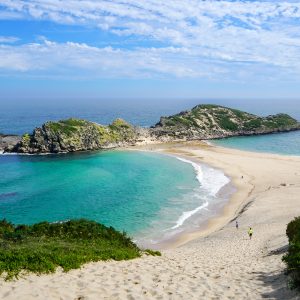
Oh, how we’ve wanted to return to South Africa for so long! And in 2023, we finally made it back: a road trip through South Africa, starting from Johannesburg. 9n this road trip, we’re climbing high in Lesotho and the Drakensberg Mountains We search for adventure and the Big 5 in the South African game parks. We also spend a few days exploring Johannesburg. And we’re doing much more. For over four weeks, we are road tripping through the South African provinces of Gauteng, Free State, Lesotho, KwaZulu-Natal, eSwatini, and Mpumalanga. In this travel blog, you’ll find the ultimate day-to-day itinerary through South Africa, Lesotho, and eSwatini, including all our accommodation tips!

* This article contains affiliate links. If you book or purchase something through this link, we’ll earn a small commission at no cost to you.
Why South Africa, Lesotho and eSwatini?
This is one of the greatest road trips in the world! From one of the best wildlife parks to some of the most spectacular mountain ranges in Africa. Beautiful beaches, good roads, endless forests and some amazing ecological formations come together with a range of local cultures. Not too forget Johannesburg and Soweto’s intense urbanity. This road trip has got it all.
In 2009, we already traveled for four months on a road trip through South Africa, Namibia, Botswana, Zambia, Malawi, and Mozambique. Starting and ending in Cape Town, we also spent six weeks in South Africa. But in those six weeks, we didn’t see nearly everything South Africa has to offer. We’d really like to go back right after that.
Now, after 14 years, we’re finally back in South Africa, and we’re also taking the time to visit Lesotho and eSwatini. These two mini-kingdoms truly have their own distinct history and culture. They’ve developed differently than South Africa. Lesotho, in particular, with its mountains and pastoralists, is truly different and unique. eSwatini is a nice stopover on the way from Durban to Kruger National Park.

South Africa Road Trip: Map of our four-week itinerary
READING TIP – Do you also love a good road trip? Then also read (in Dutch using Google Translate) Road Trip through Portugal – Our Route and Tips for Three Weeks of Travel and
Road Trip Oman: Our Four-Week Itinerary
+++++++++++++++++++++++

Day-by-day itinerary, driving times and accommodation tips: Road trip South Africa, Lesotho and eSwatini
Including flights to and from the Netherlands, this South African road trip takes 32 days, with 29 nights and 28 full days in South Africa, Lesotho, and eSwatini. We rent a sturdy car through Sunny Cars, but not a 4WD, which we pick up and return at OR Tambo Johannesburg Airport.
- 4.414 kilometers
- 402 kms longest ride in kilometers (Graskop – Johannesburg)
- 8.5 hours longest ride in time (Clarens – Sani Pas via Calendonspoort with a blocked road and breakdown; should be possible within 6 hours)
- 6 days of seeing lions
- 1 boat tour (in St.Lucia)
- 31 nights, including two night flights
- 3,200 m highest altitude in Lesotho on the road to the Sani Pass

TIP – How much does a South African road trip actually cost? Check out our
budget for this South African road trip from Johannesburg, and our tips on how to do a South African road trip yourself on a smaller budget.
Find your flight to South Africa on Trip.com here:
This was our itinerary around South Africa, Lesotho and eSwatini day by day.
Day 1 – 4 Johannesburg
From Amsterdam to Johannesburg: 11 hours direct flight; with a stopover the flight time is approximately 16-20 hours.


Johannesburg is the largest city in South Africa. Many people skip Johannesburg. We understand that, because the city doesn’t have a good reputation. But we think that’s a real shame.
History
In Johannesburg, we rediscover South Africa’s impressive history. In Soweto, on Constitution Hill, and at the Apartheid Museum, the stories of this country stay with us. We’ve already visited the Apartheid Museum before, but once again, the profound injustice of apartheid stirs emotions within us. Johannesburg is a must for anyone who wants to better understand modern-day South Africa.
We recommend everyone to visit the Apartheid Museum and Soweto. If you have more time, also visit Constitution Hill, the former British fort and apartheid prison in the city center where both Gandhi and Mandela were imprisoned.
ALSO READ (In Dutch: English by Google Translate) – Johannesburg or Not? Seven Reasons Not to Skip This City


Soweto
Soweto is the largest township in South Africa. After 14 years, we’re eager to return to this part of Johannesburg to see it for ourselves. We’re organizing a tuk-tuk tour with Lebo’s Backpackers. This hostel is located in Soweto and is run by locals. We drive there ourselves and park our car safely at the hostel for the day tour. You can also arrange a day tour with pickup from another part of the city.

This is an impressive tour through Soweto, giving us a glimpse into daily life in the townships. Nelson Mandela and Desmond Tutu lived in Soweto. You can also visit Mandela’s house, which is now a small museum. Soweto is no longer just a poor part of town. These days, you’ll also find more affluent houses and neighborhoods here. The best museum in Soweto is the Hector Pieterson Museum, which commemorates the 1976 student uprising.

Sleeping in Johannesburg
On arrival in Johannesburg and on the way back, we are staying in the Melville neighborhood, which has a few nice restaurants and shops (recommended: Love Books). We also stock up on supplies for the rest of the trip. The supermarkets of Johannesburg are better stocked than outside the big city. In Johannesburg, we first stay at Arum Place Guest House and on the way back, at Melville Turrett House.

Budget – Soweto – Lebo’s Backpackers – Nice rooms in a cozy hostel in Soweto.
Mid-range – Melville – Melville Turret House – In one of Melville’s most beautiful old houses, within walking distance of the restaurants on the main street. We stayed in the studio apartment in the attic.
Mid-range – Airport – Sunrock Guest House – A popular mid-range guest house not far from the airport with good reviews for atmosphere and staff.
Mid-range – Airport – Premier Hotel O.R.Tambo – Typical airport hotel with decent rooms and a good pool. Good reviews.
Luxe – Melrose – Peech Hotel – Beautiful and eco-friendly boutique hotel with a lovely green garden and pool. Certified for fair trade tourism.
Looking to stay in or around Johannesburg? Search here for more accommodations:
Should you drive into Johannesburg when arriving at Johannesburg airport?
It is perfectly OK to drive into Johannesburg if you take some precautions. Do not drive at night and make sure your navigation app takes the highways, avoiding shortcuts through the streets of the city center. Take care with erratic drivers. Do you prefer not to drive through Johannesburg but still want to see the sights? Then you can stay near the airport and take day tours into the city. There are also Ubers driving around Johannesburg. If you’ve rented a car, be sure to check for parking availability when booking your hotel.
Day 4 – 5 Clarens
From Johannesburg to Clarens: approx. 4 hours by car, 350 km

Clarens is a sleepy village in the Free State province. It’s nestled among beautiful low mountains at the foot of the high Drakensberg Mountains (Maloti Mountains in Lesotho). With a good selection of B&Bs, restaurants, two gas stations, a mini-supermarket, and even a bakery, it’s a convenient stopover on the way to Lesotho. For more extensive grocery shopping, the Superspar in Harrismith is the best place to go on your way from Clarens to the Northern Drakensberg Mountains or vice versa.
The Calendonspoort border with Lesotho is only 45 minutes away. Less than half an hour in the other direction, you’ll find Golden Gate Highlands National Park. The regular road takes you between the beautiful, steep mountains of this national park, but with a Wild Card or day ticket, you can also drive one or more loops.

Accommodation in Clarens
Budget – Rosewood Corner – A budget option almost in the heart of Clarens.
Mid-range – We are staying at Clarens Retreat. The host is super friendly and the location is great at the entrance to the village. Within walking distance of restaurants and shops. Highly recommended.
Mid-range to luxury – IL Castello – Highly rated, charming accommodation on the edge of the village. Fantastic views.
Day 5 – 7 Lesotho: Sani Pass
From Clarens toSani Pass (via Calendonspoort border) – 259 km – approx. 5 – 6 hours by car


With its own distinct identity, Lesotho is truly different from its neighboring South Africa. The highlands have a unique atmosphere of isolation. As soon as you cross the border, you enter a different world. Villages here have no divisions between the “white” village and the “black township” as you see it so often in South Africa. Shepherds are clothed in the national dress of blankets and hats. Hundreds of sheep roam the road and the plains, men ride horses (the famous Basuto ponies), and we saw a local dance attracting dozens of visitors in a random roadside village.
The Sani Pass
The Sani Pass is one of Lesotho’s many high mountain passes. You can drive into Lesotho from South Africa via this pass on a steep 4×4 track. You can also take 4×4 day tours up the Sani Pass from Underberg. Or you can drive there from Lesotho, as we did. You don’t need a 4×4 then, but a sturdy vehicle that can climb mountain slopes is very useful.
Allow plenty of time to drive to the Sani Pass. We got stuck behind a jackknifed truck, and that can happen anytime. You really don’t want to be driving on the mountain roads in the dark. At the top of the Sani Pass is a lodge where you can sleep and from where you can take beautiful day hikes. We walked an unofficial route from the Sani Mountain lodge with stunning views over the cliff edge.


Sleeping in Lesotho: Sani Pass
Budget to luxury – Lesotho – Sani Mountain Escape – With bungalows,
camping spots, and a separate backpacker’s area with a shared kitchen and bathroom, this mountain resort offers everything from basic to luxury. It’s the only place to stay near the Sani Pass that’s actually at the top. Simply excellent. And with Africa’s highest pub, you can also enjoy some good food here.
One of the few other accommodation options in Lesotho on the road to or from the Sani Pass is 1010 On the Edge. You’ll find this hidden gem in Mokothlong, 55km from the Sani Pass, where you’ll also find shops.
Budget – South Africa – Sani Backpackers Lodge. You can choose to sleep at the foot of the Sani Pass (in South Africa). There are many accommodation options here, with this being the most popular.
Mid-range options on the South African side:
And this luxury option and still somewhat affordable resort is also nearby:

Day 7 – 9 Lesotho: Tsehlanyane NP
From Sani Pass to Maliba Lodge (Tsehlanyane NP) – 248 km – approx. 5 to 6 hours by car

Tsehlanyane National Park is located in the lower mountains of Lesotho’s interior. We enjoy a lovely walk through the green valley surrounding Maliba Lodge and even encounter the shy eland antelope. There are also monkeys here. Horse lovers can also ride around on the backs of basutu ponies. We’re glad we brought our raincoats, as a shower is expected in the late afternoon.

Sleeping in Lesotho: Tsehlanyane NP
Mid-range to luxury – Maliba Lodge – Luxury bungalows at Maliba Mountain Lodge and larger (and affordable) group accommodation / chalets at Maliba River Lodge are the only sleeping options inside Tsehlanyane National Park. These two lodges are essentially one, occupying a few square kilometers of land and featuring a large main building with a restaurant.
Budget – Maliba Lodge – Rondavels (river huts) are available at Maliba Lodge by the river. Upon request, cheaper rooms near the main building on the hill are sometimes also available. These budget options (for near-mid-range prices) can be booked directly with Maliba Lodge. Officially, there is no camping, but it may be possible if you ask.
Day 9 – 11 Northern Drakensberg (Royal Natal NP)
From Maliba Lodge to Thendele Camp (Royal Natal NP) – 229 km – approx. 4,5 to 5 hours, including a border crossing
Caution! Google Maps directs you towards Royal Natal National Park over the bridge at Bonjaneni, but it is closed to cars. There are large signs 500 meters after the Tower of Pizza, where you should turn right and then left to drive past Hlalanathi Resort on a smaller, winding road towards the national park entrance.

The Drakensberg Mountains, surrounding Lesotho, are a wonderful place for holidays and hiking. The views of the mountain peaks are breathtaking everywhere. In most valleys, there are good, clearly marked walks, ranging from easy to challenging. Something for everyone. In the Drakensberg Mountains, you’ll find just the right mix of tourism and remote, wild landscapes, especially outside the peak season.

We choose to stay in several locations so we could explore different valleys. But if you prefer to stay in one place and make day trips from there, I’d choose the Champagne Valley (Monk’s Cowl) or a centrally located lodge. We’re spending two nights in Royal Natal National Park in a bungalow overlooking the spectacular “Amphitheater” mountainside. Then we move on to the valley dominated by Champagne Castle. Just the names of those mountains!


Sleeping in the Northern Drakensberg Mountains
Budget – Amphitheater Backpacker Lodge – Good budget option on the main road along the Northern Drakensberg Mountains. One of the few true backpackers in the region. Occasional partying.
Budget to mid-range – Thendele Rest Camp – We spend two nights in a self-catering bungalow at this camp within the Royal Natal National Park. Camping is also available. You can book directly through the KZN Wildlife website, which manages all parks, accommodations, and campsites in KwaZulu-Natal.
Mid-range – Hlalanathi Drakensberg Resort is another good option. Near the entrance to Royal Natal National Park, this is a lovely resort with reasonably reasonable prices.
Luxury – Witsieshoek Mountain Lodge – Perched on the ridge of the Northern Drakensberg Mountains, this lodge is a great base for exploring the Drakensberg ridge.

Day 11 – 12 Central Drakensberg (Monk’s Cowl)
From Thendele Camp to Inkosana Berg Lodge – 101 km – approx. 1,5 to 2 hours by car
The valley at the foot of Champagne Castle, also known as Monk’s Cowl, is one of the most developed valleys in the Drakensberg Mountains. You can even find real croissants and good food at The Valley Bakery. Don’t expect a village. Scattered among the rolling hills, you’ll find paths leading to accommodations with views, restaurants, and farms hidden from the road. Several marked walks in the Ezemvelo KZN Wildlife Reserve begin at the end of the road. We are doing a short hike to the Sterkspruit Waterval.

Sleeping in the Central Drakensberg Mountains
Budget – Monk’s Cowl Campsite en Caravan Park – Camping at the gate of the nature reserve. Campsites can be booked through the KZN Wildlife website.
Budget to Mid-range – Drakensbergen Inkosana Lodge – Our choice. Beautiful garden in various sections and a “natural” swimming pool surrounded by birds. A fifteen-minute drive from Monk’s Cowl, where several walks begin. Inkosana offers beautiful, modern rondavels as well as simple rooms. Highly recommended.
Luxury – Dragonview Lodge – Truly luxurious with attention to beautiful, stylish details, and a price to match. People also come specifically for the restaurant with its spectacular views.


Day 12 – 13 Ballito (Durban’s Northern Beaches)
From Monk’s Cowl to Ballito – 270 km – 3,5 to 4 hours by car
To break up the journey from the Drakensberg to Hluhluwe-Imfolozi Game Reserve, we’re making a stop in Ballito. A good place to stop on the way to the coast is The Windmills, where you can refuel, find the “cleanest toilets in South Africa,” a good restaurant, and some delicious sandwiches. The beaches north of Durban are also a beach destination in their own right, with many hotels, good supermarkets, and a few nice restaurants. We’re also here to stock up on supplies at the Ballito Lifestyle Centre, which has a SuperSpar and a Woolworths supermarket, before heading to Hluhluwe-Imfolozi.
You can take a pleasant stroll along the boardwalk at Ballito, along the beach. Unfortunately, the weather isn’t great during our stay, so we mainly take some time to relax.


Sleeping in Ballito
Budget – Regal Inn Ballito – Excellent value for money and close to the shopping center. Simple but spacious rooms.
Mid-range – Beach Forest Lodge – This is where we stayed. Decent accommodation with a cozy courtyard featuring a pool, koi fish, and a green design. Choose between an affordable studio or very spacious, slightly more expensive family apartments.
Luxe – The Seaglass – Perhaps the most beautiful view in Ballito, in a meticulously designed architectural masterpiece. Luxurious swimming pool and floor-to-ceiling windows.

Day 13 – 16 Hluhluwe-Imfolozi Game Reserve
From Ballito to Mpila Rest Camp (Hluhluwe-Imfolozi) – 217 km – 3 to 3,5 hours by car
From Mpila Rest Camp to Hilltop Rest Camp – 43 km – 1,5 hours driving – You can also take game drive loops along the way to look for animals. Some routes may be closed during the rainy season.

Hluhluwe-Imfolozi is a beautiful, compact game park. It’s only a few hours’ drive from one end to the other. At the end of the rainy season, it’s beautifully green here. We think it’s definitely worth including in your road trip itinerary through this part of South Africa. We had the animals and landscapes practically to ourselves for the first few hours of the day, as we stayed in a small-scale accommodation right in the heart of the park. If you stay outside the park, it would easily take an hour or an hour and a half to see an elephant.
Two parts, one wildlife park
The northern part (Hluhluwe) boasts beautiful mountains and is very green. There’s a good chance of seeing rhinos, and especially lots of buffalo, zebras, and nyalas. The southern part (Imfolozi) is teeming with wildlife, with many elephants and giraffes. And with a bit of luck, we might even see rhinos in Imfolozi. We even see cheetahs here (and a lion’s tail)!
Hilltop Camp (in the Hluhluwe section) has a terrace near the restaurant with stunning views and warthogs, nyalas, vervet monkeys, and buffalo that come close.

The major rivers of Hluhluwe-Imfolozi are flooded when we’re there. This makes our visit even more adventurous than it already is. Not all tracks are accessible. And sometimes we’re faced with the choice of whether or not to drive through a river. You can also book game drives from the camps. Unfortunately, it rains on the day we want to do that.


Sleeping in and around Hluhluwe-Imfolozi
Budget – Hluhluwe Backpackers – The budget option with simple rooms not far from the park gate on the north side of Hluhluwe-Imfolozi. We stayed there in 2009, and it still exists! You can camp here with a campervan.
Mid-range t/m luxe (inside the game reserve) – Mpila Rest Camp – Safari tents and large self-catering bungalows in this small-scale camp. The bungalows have beautiful views and are clean. They are a bit dated, though. Oddly enough, there’s no lock on the door. We brought our own padlock. Next time, we’d try a safari tent; people rave about them too. Although this camp is basic, we think it’s incredibly worthwhile to sleep in the middle of a game reserve. It has a gas station (not always staffed).
Mid-range to luxury (inside the game reserve) – Hilltop Rest Camp – From the restaurant terrace and the more expensive bungalows, you have expansive views of the surrounding hills. There are also simple budget rondavels with a shared kitchen and toilet/shower. This is where we stayed. Cooking equipment is available. Slightly larger than Mpila. It has a gas station.
Mid-range – Hluhluwe Gate Safari Camp – The closest option just outside Memorial Gate. Simple accommodation, but locally owned. Reasonably priced and definitely worth considering.

Day 16 – 19 St.Lucia and the iSimangaliso Wetlands
From Hilltop Camp to St.Lucia – 82 km (via N2 of via the Link Road and the R618 in Hluluwe-Imfolozi) – 2 hours by car
The village of St. Lucia is a popular holiday destination for South Africans and families. This village is the gateway to the iSimangaliso Wetlands and is nestled between coastal forests and a hippo-filled river. You can venture out onto the river here in search of hippos. We’re going on a boat tour with Shakabarker Tours, guided by the owner, a former Lonely Planet author who passionately shares his stories about the wetlands and conservation.
Check out more and book your St.Lucia tours on Get Your Guide.

Many people also come to St. Lucia for the beach. You can walk to the sea on a boardwalk in St. Lucia or drive to Cape Vidal, located in iSimangaliso Wetland Park. If you want to swim and relax, Cape Vidal is the place to be. The bonus is that you can spot zebras, buffalo, and kudus on the way to Cape Vidal.

St. Lucia: some love it, others think it’s best skipped. We just spent three days in the bush of Hlhluwe-Imfolozi. For us, St. Lucia is mainly a place to do laundry and recharge for the next leg of our road trip. There are also several restaurants here for dining out, and a few small supermarkets. We find it a bit boring here after our adventure in Hlhluwe-Imfolozi. But where else can you encounter hippos while walking the streets at night?
The region around St. Lucia can also be an interesting base for a day trip to Hluhluwe-Imfolozi . You can combine a visit to iSimangaliso and Hluhluwe-Imfolozi.

Sleeping in St. Lucia
Budget – Camping options are available at various campsites in and around St. Lucia. We think the best option is iSimangaliso Wetland Park near Cape Vidal. Basic bungalows are also available there. Bookings can be made throughBoeken kan via KZN Wildlife.
Mid-range – St.Lucia Ecolodge – This is where we’re staying. It’s one of the few ecolodges we’ve encountered with features like solar panels. We treat ourselves to a room with a sea view, and it is definitely worth it. It’s a bit pricey for what you get, but that’s true for many accommodations in St. Lucia.
Mid-range – The Sandpiper – A place where everything seems to have been given a little extra attention. Very good reviews.
Mid-range to luxury – Hluluwe Bush Camp or their Hluluwe Bush Glamping Village. This Dutch-owned place is a lovely alternative to staying in the village of St. Lucia, located in the area along the western shores of Lake St. Lucia and the iSimangaliso Wetlands. From here, you can visit both Hluhluwe-Imfolozi and the various parts of iSimangaliso.
Day 19 – 21 eSwatini (Swaziland): eZulwini valley
From St.Lucia to the eZulwini-vallei – 334 km – 5 to 6 hours by car

eSwatini (Swaziland) is a small country bordered by South Africa and Mozambique. It takes three hours to get there by car. We cross the border at the Lavumisa Border Post (MR8 highway), which is very smooth and quick. Returning to South Africa, we take the well-paved MR5 and cross the border again at the Mananga border post within fifteen minutes.
The eZulwini Valley is the most touristy region of eSwatini, and we’re incredibly curious to see it. This is a truly unique region. We end up at a backpacker lodge where a large group of young volunteers are staying. It’s a beautiful place, but a bit crowded.


Mantenga Cultural Village
A local guide takes us on a tour of Mantenga Cultural Village, a living museum about traditional Swazi culture. We don’t usually attend cultural dances. We find that a bit awkward. But we’ve wanted to visit a living museum to see what it’s like. At Mantenga, they are very proud of their own Swazi culture, and even school classes from all over eSwatini come here to learn about the traditions of their own culture.
Near Mantenga, we also drive to a beautiful waterfall with a picnic area where you can have lunch. They’re building a new restaurant. Check beforehand to see if it’s open. You can also stay overnight in one of the riverside bungalows.


Mlilwane and Swazi Candles
In the afternoon, we visit Mlilwane Wildlife Sanctuary. There are no predators in this park, but there are zebras, blesbok, kingfishers, and fish eagles. The great thing about this is that you can walk around here (independently) or even rent a bike to cycle among the antelope. We are having lunch at the Hippo Restaurant in the sanctuary. The forests and hills surrounding the open savannah complete the beautiful setting. There’s also a large camp here where you can sleep in modern, thatched beehive huts. Many tour groups also come here.
Swazi Candles is a local candle factory 20 minutes from Mlilwane. Here, we see how they make their unique candles on-site. A whole market has sprung up around this candle factory and shop, selling locally made handicrafts. We buy a few unique souvenirs.


Sleeping in the eZulwini-valley
Budget – Lidwala Lodge/Backpackers – (also houses volunteer groups) or Sondzela Backpackers.
Mid-range – For a different experience, stay at one of the nature reserves in the eZulwini Valley. At Mantenga Nature Reserve & Cultural Village you can book a bungalow with a view of the river and Execution Rock. Mlilwane NR Camp & Campsite is located in the heart of the nature reserve, home to zebras, blesbok, and many other animals. A beautiful spot with modern beehive huts, simple chalets, and a large restaurant.
Mid-range – Mantenga Lodge – This is one of the best value options outside of the nature reserves in the eZulwini Valley. Beautiful rooms nestled among the trees.

Day 21 – 26 Kruger National Park
From eZulwini-vallei to Crocodile Bridge (Kruger NP Park Gate) – 200 km – 3,5 hours by car, including a border crossing
From Crocodile Bridge to Lower Sabie Rest Camp – 32 km – 1.5 to 2 hours (max. speed is 40 km/h, but allow for a maximum of 20 to 25 km/h plus time you stop for animals)
And from Lower Sabie Rest Camp to Satara Rest Camp – 96 km – at least 3 to 4 hours – stop for brunch at Tshokwane Trading Post. We took the whole day.
TIP – Read for more details and more accommodation tips – Self-drive in Kruger National Park: Now the best routes, our practical tips and unique places to sleep

Kruger National Park is the largest game reserve in South Africa. It’s half the size of the Netherlands. This protected area even extends into Mozambique and Zimbabwe. Together, they form the Great Limpopo Transfrontier Park. On a previous trip, we spent a week in Kruger. Back then, we only saw the northern part. Now we’re exploring the south of Kruger National Park. The landscapes and wildlife in the north and south are truly different, with different trees, plants, and climates.

Lions in Kruger National Park
The moment we drive into the park and see large herds of elephants, zebras, giraffes, and buffalo is overwhelming. We pass through the gate at Crocodile River and within the first hour, we see all sorts of animals. This continues for the rest of our six days in Kruger, though of course, you sometimes see more, sometimes fewer. Later, we also do two sunset drives from Satara Rest Camp: highly recommended because you’re not allowed to enter the park after dark, when the big cats are most active.
Over the next few days, we’ll see lions five times. We’ll be in the National Park for six days and five nights. Seeing animals requires time and patience. We therefore recommend spending at least three full days in Kruger National Park.
Safety around Kruger National Park – There is one access road to Kruger National Park, which has been the subject of numerous reports of robberies and carjackings in recent years, even in 2023: the road from the R538 to Numbi Gate. Avoid the R538 between Hazyview and White River, and Numbi Gate as an entry or exit from Kruger National Park. Phabeni Gate and Kruger Gate are good and safe alternatives.

Sleeping in Kruger National Park
Accommodation options inside Kruger National Park
Budget to mid-range – The SAN Parks rest camps in Kruger National Park – We prefer to stay in the national park. We’ll spend our nights in Kruger National Park at two different SAN Parks rest camps: Lower Sabie Rest Camp and Satara Rest Camp. During our previous trip, we camped at Letaba Rest Camp, Punda Maria Rest Camp, and Shingwedzi Rest Camp.
You can book accommodations in Kruger National Park through the SAN Parks website. You can choose between self-catering bungalows, safari tents, bungalows with shared kitchens and bathrooms, and camping sites. You also have the option of sleeping right in the bush in huts or at camping sites in the bushveld camps and satellite camps within the national park. There are 21 (!) SAN Parks camps to choose from, nestled in the heart of nature.
Luxury – within Kruger National Park – Many people don’t realize that luxury lodges also exist within Kruger National Park. In these secluded private boutique lodges (“concessions”), you’ll be pampered and taken on exclusive game drives amidst the park’s stunning natural beauty: Hoyo Hoyo Safari Lodge, Imbali Safari Lodge or Hamiltons Tented Camp.
Accommodation options outside Kruger National Park
Budget to luxury (outside the game reserve) – Prefer something more comfortable than the rest camps, but find the private game reserves a bit much? Then you can also stay outside the park and take day trips to Kruger. In Marloth Park on the south side of Kruger, just outside the gate, you’ll find dozens of lodges in a park-like setting teeming with wildlife. Alternatives outside the park boundaries can be found near the villages of Hazyview or Hoedspruit (Maruleng) on the west side.

Luxury – private game reserves ‘Greater Kruger’ – The private game reserves Sabi Sands Game Reserve and Manyeleti Game Reserve appeal to us the most. They insist on a no-hunting policy. Inyati Game Lodge and Elephant Plains Game Lodge are two beautiful lodges in the Sabi Sands area. Ndzhaka Tented Camp and the Honeyguide Tented Safari Camps in Manyeleti Game Reserve are equally stunning.

Day 26 – 28 Graskop and Blyde Canyon
From Satara Rest Camp to Graskop (Zur Alten Mine) – 195 km (via Phabeni Gate) or 170 km (via Orpen Gate) – 4 to 5 hours by car
Graskop and Blyde River Canyon are a great stopover on the way from Johannesburg to Kruger National Park, or vice versa. On a mini-road trip of over 50 kilometers there and back, you can visit various viewpoints along the Panorama Route. The Three Rondavels and Bourke’s Potholes are the most famous spots in the Blyde River Canyon region. Each viewpoint has a separate entrance fee of a few euros. At Bourke’s Potholes, you can also opt for a day hike on one of the marked trails.

The region boasts several charming villages with shops and restaurants. Be sure to choose the location of your accommodation carefully, as the winding roads through the forests can take longer than you think. Plan at least a day for the Panorama Route road trip. If you enjoy hiking, it’s a good idea to stay longer. We would have loved to have a few more days here before heading home.

Slapen bij de Blyde River Canyon
Budget – Joy River Backpackers in Moremela, near Bourke’s Potholes.
Mid-range – Zur Alten Mine (Graskop) – We are staying in one of the detached cottages in a green garden with a large pond and a walking path through the forest. A five-minute drive from Graskop. Highly recommended.
Mid-range – Havana Nights (Graskop) – If you prefer to stay in the center of the village of Graskop, with restaurants within walking distance. Clean, simple rooms with a touch of love and friendly staff.
Day 28 – 30 Johannesburg and back home
From Graskop to Johannesburg – 404 km – 5 to 6 hours by car
At the end of our South Africa road trip, we arrive back in Johannesburg. We’ve reserved this last day for visiting family and friends, and for leisurely packing. We return our Sunny Cars at the airport
+++++++++++++++++++++++

○ How many weeks for a South Africa road trip from Johannesburg?
We took over four weeks for this road trip. You could easily do this South Africa road trip in three weeks. We like to travel slowly and take plenty of time for the places and activities we enjoy. But if you have less time, you can easily adapt this itinerary to a three-week road trip. For example, you could reduce your time in:
- Johannesburg: 2 nights instead of 5 nights
- St.Lucia and Hluhluwe-Imfolozi: Combine both destinations over 3 nights instead of spending 3 nights at both
- Lesotho: 3 nights instead of 4 nights
- Ballito: Don’t make a one-night stopover, but go straight to St. Lucia
Other variations on our itinerary are to travel from Johannesburg to Kruger National Park first, then head down to Durban and fly from there to Port Elizabeth or Cape Town. This would skip Lesotho. If you’d still like to include Lesotho, we’d drive from Lesotho via Camdeboo National Park in the Karoo and then along the Garden Route to Cape Town. We’d take at least four weeks for this. Ideally, six weeks, or 10 weeks, or… three months!
○ What is the best season for a road trip in South Africa?

Consider rainy seasons
We’re doing this road trip through South Africa, Lesotho, and eSwatini in March. In this part of South Africa, March marks the end of summer and the end of the rainy season. We found it manageable, despite the occasional late afternoon shower. However, rivers and roads in Hluhluwe, St. Lucia, and Kruger National Park had flooded a few weeks earlier, making parts of the parks inaccessible.
Our summer, winter in South Africa, is considered the best season for safaris. It’s drier then, so animals gather at waterholes. The grass is also shorter. It can be quite cold in the early mornings and evenings, though. So definitely bring a sweater and jacket during that season.

Spring or autumn
The grass is also quite high this March season, and there’s a lot of water, making animals more dispersed and harder to spot. Nevertheless, we saw a lot of animals in the wildlife parks. Because it was the off-season, it was pleasantly quiet in many places. Autimn is the best season for wildlife viewing when it’s dryer and with less high grass.
In Lesotho, spring and autumn are the seasons when it’s not yet too cold or wet. Due to the altitude of around 2,500-3,000 meters, it’s always considerably colder here than in South Africa. In winter, there’s snow in the mountains and ice on the roads. Roads and mountain passes are also closed.
The region around Cape Town has a very different climate. For the Garden Route and Cape Town, summer (our winter) is an ideal time. It has a more Mediterranean climate.

○ Is South Africa safe?
We always find this a bit of a difficult question to answer. It’s a very personal experience. Whether you feel safe also depends on your travel experience, where you live, and your personal personality. There’s also no single answer for South Africa as a whole. Every place is different.
We spent a lot of time in the countryside, in small villages, and out in nature. And we generally felt safe there. Always ask your hotel for advice on where and when it’s safe and when it’s not. A general rule everywhere in South Africa: use your common sense and always remain somewhat alert. For example, always lock your doors and leave your expensive belongings and jewelry at home, or at least don’t show them when you’re out and about.

Johannesburg is a unique situation safetywise. It’s simply an unsafe city. But if you follow certain rules, you can still do your thing here. For example, don’t walk the streets after dark and, also here, listen to local advice from your hotel. Act like you belong there and plan your travels carefully beforehand. Avoid the city center, such as the Hillbrow neighborhood.
Wildlife parks with predators pose different dangers. Here are the two most important rules: stay in your car, and give elephants plenty of space.

○ What is ‘loadshedding’?
Due to a power shortage in South Africa, electricity is being shut off for a few hours each day. This is called “load shedding.” The times vary by neighborhood, city, and region. You can use the ESP app, for example, to check when the area where you’re staying is up for load shedding. Ask your hotel about the load shedding times. Load shedding can also cause tap water to be unavailable, especially in the cities. Check with your hotel about this as well.
When booking a hotel, it’s worth checking if they have a backup system for electricity. You can often find this information in reviews. Ideally, they should have solar panels. Eco-hotels are a great option for this reason, and much more environmentally friendly than hotels with large diesel-powered generators.
In any case, it’s handy to bring a large power bank. Good headlamps and a flashlight also deserve a place in your backpack or suitcase.

○ Cash or creditcard in South Africa?
You can get by quite a bit in South Africa with a credit card. We were able to pay a lot with our credit card, for example, at supermarkets and gas stations. You can also withdraw money from ATMs in South Africa with your regular debit or credit card.
However, we recommend carrying cash. This South Africa road trip takes you to remote areas. Internet connections there aren’t always reliable. This means credit card payments sometimes simply don’t work. This happened to us, for example, at a rest camp in Kruger National Park. Bring enough cash for a few days.
For everyday payments, we use Revolut cards. This is a VISA prepaid card. Withdrawing cash is free up to a certain amount per month and is always cheaper than using your debit or credit card. It’s best to withdraw cash in shopping malls with security, at gas stations, or in supermarkets. This isn’t always possible. Ask your hotel if it’s safe. If possible, go with a friend when taking out cash.

○ Renting a car in South Africa: 4wd or 2wd?
We rented a car through Sunny Cars for our road trip through South Africa. We chose a 2WD SUV: a slightly larger car than we normally would, as we wanted something more robust for the mountains. It had a spacious trunk for storing luggage out of sight. You also sit a bit higher in an SUV, allowing you to see a little more above the grass in game parks. A higher car is also ideal for unpaved roads and driving over flooded roads.

The roads and unpaved tracks in the wildlife parks we visited on this trip were easily manageable with a 2WD. The trunk of the Volkswagen T-Cross was a bit disappointing. A sedan, like a Toyota Corolla, with a large trunk would have been just as good for luggage.
Do you also want to travel to Lesotho and eSwatini with your rental car? Please indicate this clearly when booking. The rental company needs to arrange the necessary paperwork a few days in advance and give it to you when you arrive at the counter. Check this when you pick up the car. You will pay an administration fee of a few tens of euros for this on-site.
○ Our ten tips for self-driving in South Africa
Tip #1 – Distances are greater than you think
The distances are often greater than you think. A six-hour driving day is our maximum. We allow two hours for breaks and delays on such travel days. This way, we never drive more than the length of a workday. Don’t blindly rely on driving times in Google Maps. You could easily spend 20-30% longer on the road. Also, check the route yourself, because some apps will give you shortcuts that aren’t shorter at all, or are quite creative. If you’re driving yourself in wildlife parks, you’ll also be spending quite a few hours behind the wheel.

Tip #2 – Drive on the left
In South Africa, they drive on the left. We found this confusing at first, especially at roundabouts and when there’s little traffic on the road.
Tip #3 – The 4-way stop: First come, first out
In The Netherlands, the right of way is for those who come from the right. They do things differently in South Africa. At the four-way stop, there’s a stop sign for everyone. And whoever arrives first gets to accelerate first. This means most people approach an intersection very slowly.
Tip #4 – Don’t drive in the dark
In South Africa, Lesotho, and eSwatini, people, animals, and vehicles can all be on the road without lights in the dark. You might also encounter a car traveling at 30 km/h on the highway. Even in daylight, this is a challenge – we know this from experience! You definitely don’t want to encounter this in the dark. Potholes are also common, making it completely impossible to see in the dark. Load shedding can cause power outages in entire neighborhoods simultaneously. This can make the streets very dark, even in the city.

Tip #5 – Bring an International Driving Permit
You can normally purchase an International Driving Permit (IRB) through your national Automobile Association. Please note that you will unfortunately need two different IRBs for this itinerary! You need a different IRB for eSwatini than for South Africa or Lesotho.
Tip #6 – Buy a SIM card at the airport
We recommend buying a SIM card at the airport. It’s very easy. In the arrivals hall, you’ll find MTN and Vodacom shops where they’ll install the SIM card for you. In addition to internet credit, also get phone credit. This way, you can always call if you have a breakdown or arrive later than expected at a hotel. Note that with this South African SIM card, you’ll need to use roaming in Lesotho or eSwatini, which is more expensive.
Tip #7 – Download offline maps at home in Google Maps and an alternative
You won’t always have phone reception on this South Africa road trip. You’ll be visiting some truly beautiful, remote locations! If you still want to navigate with your phone, this is a great tip. We use different apps for maps to doublecheck as each sometimes suggests some too creative routes.
Tip #8 – Don’t drive through the city center of Johannesburg
Avoid the city center. It can be unsafe. Better drive through Johannesburg on highways and main roads. Make sure your Google Maps route uses highways, as Google doesn’t account for them. Always lock your doors and close your windows while driving in Johannesburg.

Tip #9 – Trucks on the hard shoulder
Many trucks drive on major highways. These are often large trucks carrying ore and coal from the mines. They often drive halfway on the shoulder, and you’re expected to overtake. Be careful when overtaking, as overtaking from the other side is also possible!
Tip #10 – Tipping on the go
There are parking attendants in many places who will watch your car for a tip. They are usually unofficial. It’s customary to tip parking attendants, whether official or not, 5 rand. Ten rand is also acceptable. This also applies to the people who fill your tank and wash your windows at gas stations. So make sure you have some cash on you when you’re on the road.
Find your flight on Trip.com